Fridge magnets of the Southwest
The history and meaning behind Mexican souvenir jackets
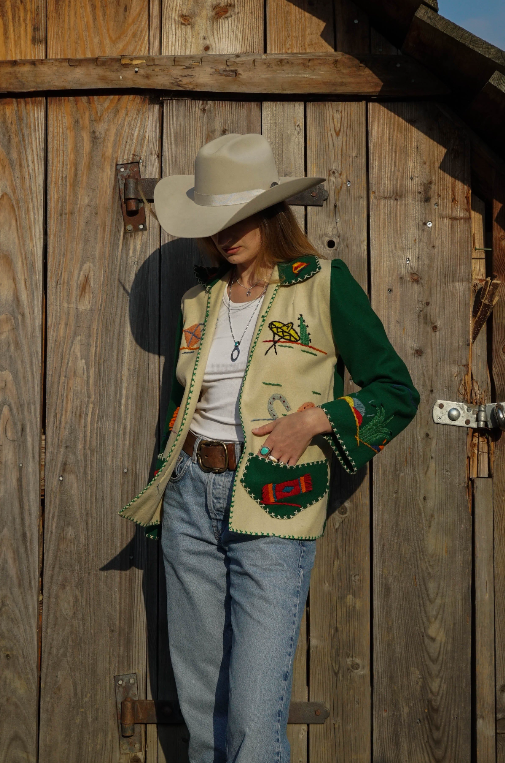
If you're into Western Wear or 1940s fashion, you've seen plenty of these colourful jackets embroidered with scenes of the dreamy Southwest - deserts, cacti, donkeys and long-haired senoritas, all depicting Mexico. Much has been said about their styles and characteristics, but what remains unclear is their origin, so I decided to do some digging!
Mexican souvenir jackets originated in the early 1940s as a result of Mexico becoming the 'it' place for American travellers - and who wouldn't want to have a souvenir from there, especially when tourism was just picking up again after the years of war? We don't know for a fact who was behind the creation of the first one and how they became a thing, but here's what we know for sure.
In the 1930s, mariachi music and costuming began being featured in films, including El Rancho Grande, and radio broadcasts.
Mexico was a neutral country until 1942 and then as an ally, it became an attractive and accessible destination for Americans. The warming of relations between the two countries gave permission to more than 300.000 Mexican labourers to come to the US to help fight the American labour shortage.
In 1943, American Airlines opened a commercial flight to Mexico City and Monterrey from New York, San Antonio, Los Angeles and Tucson. It carried 176.000 tourists in 1949 and 400.000 in 1951. Flights on a similar itinerary - Mexico City to Texas, were already possible in 1929, operated by Pan Am, though the journey took 3 changes.
McCall Needlework, a popular craft-focused magazine (existing since 1919), featured Mexican souvenir jackets in both the summer and winter editions of their 1949 catalogues, meaning that souvenir jackets were no longer available only to those who travelled South and in fact, The Kresge Company advertised their felt by yards for sewing the jackets at home. For several years, McCall Needlework published photographs of the DIY jackets of its readers.
There is a possibility that the souvenir jackets were also available in American department stores (as suggested in this article), though no exact dates or stores are listed.
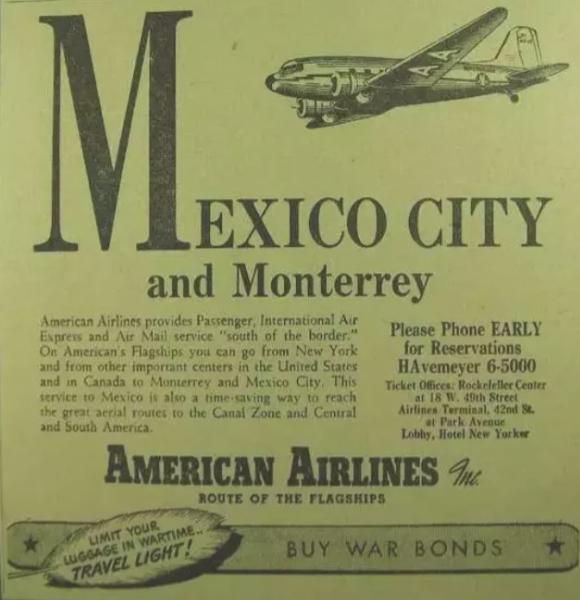
1943 American Airlines ad
At least at the beginning of the boom, all the jackets were produced in Mexico. Nine manufacturers or retailers have been confirmed until now: Berty, Casa Cruz, Garcia Leal Hermanos, Lab-Mex Trabajos Tipicos, Lopez, La Mexicana Fabrica De Ropa, Presidente, Ramirez and The House of Oppenheim (a department store founded in 1892 in Cuidad Juarez). What's interesting, is that half of the above (those that could be traced), were produced in the northern or border town sites - though the majority of the tags carry the 'Hecho en Mexico' tag, some displayed the cities or regions, like Nogales (Sonora), Ciudad Juarez (Chihuahua) or Nuevo Leon (Monterrey). This confirms the souvenir exchange of jackets among American tourists travelling near or across the Mexican-U.S. border.
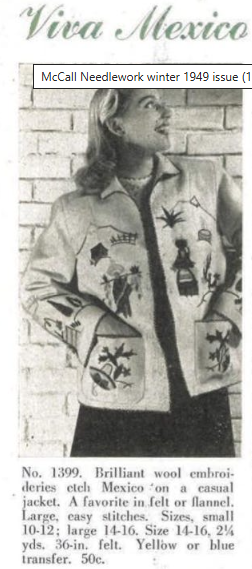
McCall Needlework winter 1949 issue
Mexican souvenir jackets are instantly recognisable due to their original design - a colourful wool applique and yarn embroidery. Available in solid black, white and primary colours, they were machine-sewn of brushed, plain-weave wool. They featured coarse embroidery with a blanket or cross-stitched finish on the raw edges and attached applique, often incorporating sequins. Motifs depicted iconic Mexican symbols and among them, one of the most popular was the dancing couple, which was no ordinary couple (at least to the Mexican eye).
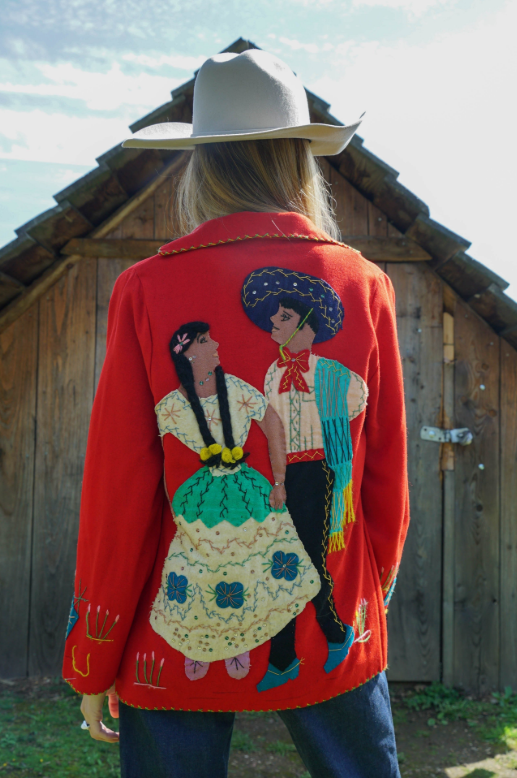
A jacket I sold a while back
It is said, that the couple represents the national duo - el charro and la china poblana. Historically, el charro was a horseman from the Mexican countryside whose riding suits were bold, colourful and loaded with adornments, whereas la china poblana represented the ideal of feminity ('china' might refer to 'China' and according to the local legend, the arrival of the Oriental princess in the 17th century, though some sources suggest an Asian-born enslaved woman brought to New Spain, who later became a saint - whatever!, 'poblana' derives from 'pueblo' meaning 'village). Oddly enough, some marketing bosses responsible for the promotion of Mexico thought that placing this woman (in a dancing scene, I forgot to add) was a great idea. Who would question that in 1943 anyway?
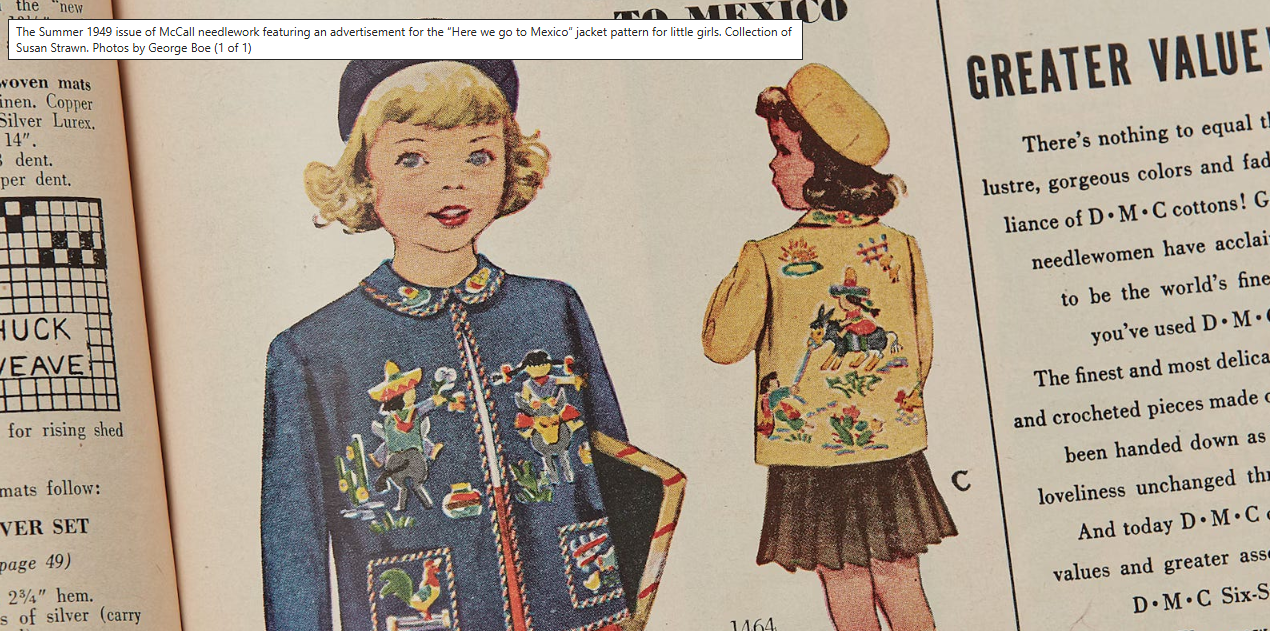
The Summer 1949 issue of McCall needlework featuring an advertisement for the “Here we go to Mexico” jacket pattern for little girls. Collection of Susan Strawn. Photos by George Boe
If produced today, would the souvenir jackets be potentially culturally inappropriate? Perhaps yes. Given the awareness of cultural heritage and new laws protecting their traditions, artisans and communities, let alone national symbols represented in fashion and souvenirs, there's much more scrutiny nowadays. The perception of these jackets has also likely changed since their popularity in the 1940s and 1950s and what was once seen as a souvenir, might now be viewed as an exploitation of cultural symbols. But the facts are - they were produced years ago (and most likely in Mexico and by Mexicans), they represent a specific era in Mexican-American cultural exchange and tourism and they feature intricate embroidery and designs showcasing traditional skills. On top of that, they carry the additional value of preserving history and can possibly spark interesting conversations about their origin (just as I was trying to do).